Posts

Showing posts with the label 16th-Century English Music
Image
Throughout September, the Daily Classical Music Post celebrates the music of 15th-, 16th-, and 17th-century England. https://youtu.be/EX5fzwkMBCQ Anthony Holborne (c. 1545–1602) is known for his compositions for lute, cittern, and consorts, and most particularly for his dance music: in 1599 he published Pavans, Galliards, Almains and other short Aeirs, both grave and light, in five parts, for Viols, Violins, or other Musicall Winde Instruments , which contains 65 of his compositions. There isn’t a great deal known about Holborne, although we do know that he enjoyed the patronage of Sir Robert Cecil, Mary Sidney, and Elizabeth I. John Dowland dedicated his lute song “I saw my Lady weepe” “to the most famous, Anthony Holborne,” so Holborne must have been well known and respected in his lifetime. One of my favourite pieces in Pavans, Galliards, Almains . . . is the galliard “Muy Linda” (No. 34). Johan van Veen says, “ The fact that almost all the pieces in this collection are dances doesn...
John Wilbye’s “Oft have I vowed”

Image
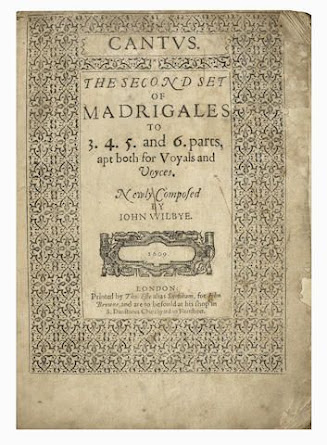
Throughout September, the Daily Classical Music Post celebrates the music of 15th-, 16th-, and 17th-century England. https://youtu.be/c_ixwO-AZnM John Wilbye ( 1574–1638) is mostly known for his madrigals, although he did compose some religious music as well as at least one piece for virginals. He never married, but his madrigals are full of stories of love and longing. Wilbye’s main influence was Thomas Morley. Edmund Fellowes once said of Wilbye (in 1915), “[I]n his two published Sets alone, Wilbye produced as many as sixty-four madrigals, scarcely any of which fall below the very highest standard of excellent, characterized, as they are, by a polished style, a keen sense of imagination, and a seriousness of purpose, showing also that their composer had a rare skill in all the musical devices known at the period in which he lived.” “Oft have I vowed” is in Wilbye’s Second Set of Madrigals for 3-6 voices, published in 1598. It is one of the darker madrigals; this is not a happy love s...

William Byrd's "All in a Garden Green"

Image
Throughout September, the Daily Classical Music Post celebrates the music of 15th-, 16th-, and 17th-century England. https://youtu.be/vuf6rCX7D-E William Byrd wrote a set of six variations for virginals on a well-known tune, "All in a Garden Green." It was included in the collection My Lady Nevell's Book (1591), although most people believe that it was written much earlier than that. The words of the popular song on which this was based went something like this: All in a garden green, two lovers sat at ease, As they could scarce be seen above the leafy trees. They lovèd lofty full, and no wronger than truly, In the time of the year cam betwixt May and July. It was very common in the 16th and 17th centuries to write variations on a tune that people would instantly identify. Byrd was a master at this, and this early work shows that. My classical music post for today is William Byrd's "All in a Garden Green."

Thomas Morley’s Magificat and Nunc Dimittis (Fauxbourdon)

Image
Throughout September, the Daily Classical Music Post celebrates the music of 15th-, 16th-, and 17th-century England. https://youtu.be/SfF3dXVezYs https://youtu.be/9sovW4pqhWQ   Thomas Morley (yes, him again) published A Plaine and Easie Introduction to Practicall Musicke in 1597. He included some vocal compositions in this book (interestingly, in “table-book” format, so the singers could stand around a table and share the same book).   Tim Eggington says, “In A Plaine and Easie Introduction Morley explained and promoted all the Italian musical forms along with their underlying aesthetic premises. The treatise is divided into three sections, with the more complex matters consigned to Annotations at the end. A remarkable feature of the work is the degree to which Morley was able to display his immense learning throughout, without seriously detracting from his instructive purpose. This was to train the average and ignorant music lover to the point where he could compose a madriga...

John Bull’s “Walsingham”

Image
Throughout September, the Daily Classical Music Post celebrates the music of 15th-, 16th-, and 17th-century England. https://youtu.be/QfcvlnDBX7k John Bull ( 1562/1563–1628) was known particularly for his music for the virginals, a small type of harpsichord common in England during the 16th and 17th centuries. He was known for his skill as a keyboard performer as well as a composer, but also for his less-than-abstemious lifestyle. Apparently, the then Archbishop of Canterbury said of Bull, “the man hath more music than honesty and is as famous for marring of virginity as he is for fingering of organs and virginals.” That pretty much says it all. Although according to contemporary accounts Bull was prolific as a composer, a good deal of his music was lost when he left England. He most likely left before being charged with adultery, although he later claimed that he was trying to avoid religious persecution. David Schulenberg says, “In the case of Bull we have a composer whose biography ...

John Redford's Angulare fundamentum

Image
Throughout September, the Daily Classical Music Post celebrates the music of 15th-, 16th-, and 17th-century England. https://youtu.be/tP01Xy3eN54 Poor John Redford (c. 1500 – 1547). By all accounts, he was one of the most important composers and dramatists of the Tudor period. Although many of his keyboard works can be found in the Mulliner Book, pretty much everything else is lost. There is one sweet little anthem, "Rejoice in the Lord alway," that was at one time attributed to him, but it has been determined that Redford couldn't have composed it because the text was unknown until two years after his death. Thomas Morley set Redford's words in his anthem "Nolo mortem peccatoris." Redford’s famous morality play, The Play of Wyt and Science, is in a manuscript in the British Library, but it is incomplete. Much of the music that Redford composed for this play is lost. The synopsis sounds like it would still be pretty much relevant today: Wit, having fallen in...

John Merbecke’s Missa Per arma iustitie: Credo

Image
Throughout September, the Daily Classical Music Post celebrates the music of 15th-, 16th-, and 17th-century England. https://youtu.be/ZfFOELPs6_E In 1550, the Anglican theologian and musician John Merbecke (c. 1510–c. 1585) published his Book of Common Praier Noted, in which he set the new English prayer book to music adapted from Gregorian chant. Apparently Merbecke had been asked to do this by none other than Archbishop Thomas Cranmer; the requirements were that it would be simple enough for anyone to sing, and that there was to be “for every syllable a note.” The image today is from Merbecke’s Nicene Creed. Merbecke had an interesting life -- the little that we know about it, anyway. He was a chorister at St George’s Chapel, Windsor, and later organist there. In 1543, he was arrested for heresy: he had in fact converted to Calvinism in the early 1540s and had managed to keep that secret for a few years. He was sentenced to burn at the stake. Fortunately, the Bishop of Winchester int...

John Sheppard's Libera nos, salva nos

Image
Throughout September, the Daily Classical Music Post celebrates the music of 15th-, 16th-, and 17th-century England. https://youtu.be/406oqiK3-x0 The wonderful English composer John Sheppard (c. 1515–1558) is one of my favourite composers of all time. His polyphony is extraordinary. He usually wrote for six voices: treble, mean, two countertenors, tenor, and bass (although today's piece is in seven voices), and his harmonies often were quite unusual for the 16th century. His enjoyment of dissonance can be heard in today's piece as well. Some of Sheppard's English settings as well as some of his Latin settings can be found in the Drexel partbooks, a set of manuscript copies compiled by John Merro in the early part of the 17th century. Merro included sacred as well as secular works, and it is a terrific resource. One of the Latin works by Sheppard included in the Drexel partbooks is his Libera nos, salva nos. Adam Binks says, "Without the proliferation of printing that ...

Giles Farnaby's "Loth to Depart"

Image
Throughout September, the Daily Classical Music Post celebrates the music of 15th-, 16th-, and 17th-century England. https://youtu.be/XwPI_WrL8tA Giles Farnaby (1565–1640) received his Bachelor's degree in music from Oxford on the same day as John Bull, who was perhaps the greatest composer of keyboard music England ever produced (well, maybe not greater than Byrd). Some musicologists have speculated that Farnaby was influenced by Bull. In any event, Farnaby was considered important enough to have over 50 of his works included in the Fitzwilliam Virginal Book, our primary source for late Elizabethan and early Jacobean keyboard music. Farnaby was in great company; the Fitzwilliam Virginal Book contains works by Bull, Byrd, Gibbons, Peerson, Philips, and Sweelinck, to name but a few. Timothy Roberts Deia says, "Farnaby stands somewhat apart, the outsider among the others who, even those who held to their Catholic faith, were trained and worked within the established Anglican wor...

Thomas Weelkes’ “Alleluia, I heard a voice”

Image
Throughout September, the Daily Classical Music Post celebrates the music of 15th-, 16th-, and 17th-century England. https://youtu.be/5KyTxg_LoFA The English composer and organist Thomas Weelkes (1576–1623) is often overlooked, partly because his church music output was overshadowed by many of his contemporaries including Byrd and Tallis, and partly because he died so young. He is now recognized as one of the masters of the English madrigal, and his four published sets are among the very best of that genre. As Chris Whent says, “Thomas Weelkes, whose professional career spanned one of the most fertile periods in England's musical history, is without doubt one of her finest composers. Like Purcell, he had a vivid imagination and love of experiment, and died prematurely at the peak of his creative powers, but not before he had composed a very large amount of music. . . . [W]ell versed in the polyphonic techniques of William Byrd, he apparently devoted his creative energies to the pro...

Orlando Gibbons's The Cries of London

Image
Throughout September, the Daily Classical Music Post celebrates the music of 15th-, 16th-, and 17th-century England. https://youtu.be/nm8RFLPC9oU https://youtu.be/mAahpO1Kw6Q Orlando Gibbons (bap. 25 December 1583–5 June 1625) was an English composer, virginalist, and organist of the late Tudor and early Jacobean periods. He was one of the leading composers in the England at that time. Although he died quite young (he was just 41), he composed a large quantity of music, for keyboards, viols, church music, and many madrigals. In the London of the sixteenth century, the cries of the street vendor, offering food, services such as knife grinding, rat-killing, and chimney sweeping, or even merely calling attention to lost belongings, were part of everyday life. Gibbons's attempt to collect this everyday ephemera into a musical setting, The Cries of London, for SATTB choir and viol consort, was not a one-off stroke of genius but part of a small repertoire of such pieces produced within a...

Thomas Morley's "Now Is the Month of Maying"

Image
Throughout September, the Daily Classical Music Post celebrates the music of 15th-, 16th-, and 17th-century England. https://youtu.be/4bZ2CfB8iDw The great English Renaissance composer Thomas Morley (1557/8–1602) composed his Ballett "Now Is the Month of Maying" in 1595, and it is one of the most famous choral works of the time. A ballett was a vocal work based on Italian 16th-century song, and was a peculiarly English form. Lionel Pike describes a ballett as "strophic, binary with repeats, using nonsense syllables, with light-hearted texts set syllabically, and in a major tonality." The masters of this form were Thomas Weelkes, Thomas Tomkins, and Morley -- and also some other guys who were not named Thomas. Balletts, madrigals, and ayres were all different types of what we now group together as madrigals. This seemingly innocuous song is, as were many of the secular songs of 16th- and 17th-century England, all about sex. Just as an example, "barley-break...

John Dowland's Lacrimae

Image
Throughout September, the Daily Classical Music Post celebrates the music of 15th-, 16th-, and 17th-century England. https://youtu.be/1MomSASPDP0 John Dowland (1563–buried 20 February 1626) was born a Protestant, but he apparently converted to Catholicism when he was 17 and went to France as a "servant" to the ambassador to the King of France. As he never made a big deal out of his conversion, this didn't stop him becoming favored by a member of Elizabeth I's court. Although he did spend several years in the employ of the king of Denmark, he was not subject to the penalties with which many recusants (those who remained loyal to the Roman Catholic Church and did not support the Church of England) had to deal. His best known instrumental work, Lachrimae, or Seaven Teares, Figured in Seaven Passionate Pavans, a set of seven pavanes for five viols and lute, was based on the theme derived from his very popular lute song "Flow my tears." It became one of the best ...

John Taverner's Audivi vocem de caelo

Image
Throughout September, the Daily Classical Music Post celebrates the music of 15th-, 16th-, and 17th-century England. https://youtu.be/oVmaZ64K3C4 John Taverner (c. 1490–18 October 1545) was one of the most important English composers of the 16th century. Most of his music is for choir: masses, Magnificats, and motets. He wrote masses based on popular songs of the day, and his "Western Wynde" mass was an inspiration to other 16th-century composers, including John Sheppard and Christopher Tye. Taverner was a master of melismata, the singing of a single syllable of text to several different notes in succession. Taverner also wrote for what appears to be soloists in the midst of some of his masses, beginning with his Missa Gloria Tibi Trinitas. This was unusual for the time. The Benedictus of the Missa Gloria Tibi Trinitas, starting at the "In nomine," became popular as an instrumental work, and many other composers wrote for viol consort and other combinations based on...

Thomas Tomkins’ “When David Heard"

Image
Throughout September, the Daily Classical Music Post celebrates the music of 15th-, 16th-, and 17th-century England. https://youtu.be/eEkx_q4eqoU Thomas Tomkins (1572–1656) was born in Wales. His father was a vicar choral and organist at St David’s Cathedral. When Tomkins was still quite young, the family moved to Gloucester, where Tomkins may have studied with William Byrd. Tomkins became a chorister in the Chapel Royal, and later studied for his BMus at Magdalen College, Oxford. He spent many years as organist of Worcester Cathedral. Tomkins was a highly respected composer of madrigals, keyboard music, and lute songs, as well as anthems and many other sacred choral works. Peter Phillips says, “Tomkins . . . was an early example of that well-known phenomenon which has characterised the careers of some of the greatest British composers. They all made a significant contribution to the music of their time, but did so in a style which, when they came to take it up, had been thoroughly exp...

William Byrd's "The Battell"

Image
Throughout September, the Daily Classical Music Post celebrates the music of 15th-, 16th-, and 17th-century England. https://youtu.be/jomZcpqkfUI The great English composer William Byrd (1543–1623) wrote his wonderfully descriptive virginals piece "The Battell" after the great Armada victory of 1588, although most musicologists believe that it is more likely to have been inspired by a smaller skirmish, perhaps an uprising of some sort. Sally Mosher has said of "The Battell": "By the 17th century, battle pieces had become a popular genre, so Byrd can be said to have launched a new keyboard genre in addition to composing the first English keyboard suite. All in C major, sections of ‘The Battle’ are harmonically very simple; for the most part they alternate between the tonic and the dominant, using no more than a handful of chords. Like the march, they often suggest trumpets and drums, but they also quite successfully suggest the sounds of soldiers marching, of ho...

Thomas Ravenscroft's "Three Blinde Mice"

Image
Throughout September, the Daily Classical Music Post celebrates the music of 15th-, 16th-, and 17th-century England. https://youtu.be/AMjPA2_CNdc The English composer Thomas Ravenscroft (c. 1588–1635) was particularly notable for his rounds and catches. He was a chorister at St Paul's Cathedral, and he did compose some well-known sacred music, including the Christmas carol "Remember, O Thou Man," but it is his secular music that really shines. I don't think that there can be anyone who hasn't heard of, and probably sung, some version of "Three Blind Mice." What most people will NOT know is that the rhyme was most likely written by Ravenscroft, and he also wrote the music. This lovely little ditty became a staple of childhood literature in the mid-19th century -- with very different words. There is speculation that the original text -- "Three Blinde Mice, / Three Blinde Mice, / Dame Iulian, / Dame Iulian, / the Miller and his merry olde Wife, / she s...

Christopher Tye’s Mass Euge bone: Sanctus

Image
Throughout September, the Daily Classical Music Post celebrates the music of 15th-, 16th-, and 17th-century England. https://youtu.be/jU5eK-LuEXM The English composer, organist, and Anglican rector Christopher Tye (c.1505–before 1573) was an important figure in the musical life of England. He was a favourite of Edward VI, and may even have taught the future king music. Even after he “retired” from the Chapel Royal after his ordination, he apparently still returned to London occasionally, as evidenced by this quote: “Dr Tye was a peevish and humoursome man, especially in his latter days, and sometimes playing on the organ in the chapel of Queen Elizabeth, which contained much music but little delight to the ear. She would send the verger to tell him that he played out of tune, whereupon he sent word that her ears were out of tune” (The Life and Times of Anthony à Wood). No one is quite sure what the title of Christopher Tye’s Mass Euge bone refers to or means. As Chris Whent says, “Prob...

William Mundy's "Ah, helpless wretch"

Image
Throughout September, the Daily Classical Music Post celebrates the music of 15th-, 16th-, and 17th-century England. https://youtu.be/1NVVgLE1m08 William Mundy (c. 1529–1591) was head chorister at Westminster Abbey, Vicar Choral to the Chapel Royal, and a Gentleman of the Chapel. He composed a large number of sacred works, and his career covered the time from Henry VIII to the early Elizabethan era. There are works in Latin and in English, including mass settings, Anglican service settings, anthems, motets, and Psalm settings. One of Mundy's most important contributions was the verse anthem. This is an anthem in which a solo voice or voices alternates with the full choir. The solo sings the "verse," which is where the name comes from. Verse anthems were very helpful for choir directors, as the choir only had to learn a small part of the anthem. Mundy's verse anthems are notable for the use of organ accompaniment. A particularly fine example is "Ah, helpless wretc...

Nathaniel Pattrick’s “Send forth thy sighs”

Image
Throughout September, the Daily Classical Music Post celebrates the music of 15th-, 16th-, and 17th-century England. https://youtu.be/UCu3uShAVYs Very little is known about Nathaniel Pattrick (?1569–1595) other than he was Organist of Worcester Cathedral and Master of the Children at Worcester Cathedral from 1590 to 1595. He apparently composed a good number of choral works, sacred and secular, but very little is extant. In 1597 he published his "Songs of Sundrye Natures, whereof some are Divine, some are madrigalles and the rest psalms and hymns in Latin, by Nathaniel Patrick, sometyme Master of the Children of the Cathedral Church of Worcester and organist of the same." This is now lost, but we do have a few consort songs that he may have arranged from these madrigals. John Bryan says that during the early part of Elizabeth I’s reign, “[c]onsort songs for solo voice and viols were particularly esteemed, since their rich polyphonic fabric shared musical interest between all ...