Posts

Showing posts with the label 17th-Century English Music

Thomas Campion’s “It fell on a summer’s day”

Image
Throughout September, the Daily Classical Music Post celebrates the music of 15th-, 16th-, and 17th-century England. https://youtu.be/Ke_KR2xopFI The English composer and poet (and physician) Thomas Campion ( 1567–1620) also trained as a lawyer but was never called to the bar. He was a true Renaissance man, in all senses of the phrase. Campion composed masques, lute songs, and ayres. He wrote his own words and set them to music himself, which was unusual at the time. Campion also wrote a work on counterpoint, A New Way of Making Fowre Parts in Counterpoint By a Most Familiar and Infallible Rule , which was published in 1615.  Campion’s “It fell on a summer’s day” was published in Rosseter’s Book of Ayres in 1601. The article on “Poetry” in the Oxford Illustrated Companion to Medicine says, that “It fell on a summer’s day” is “among the miniature glories of English poetry and music. . . . The major preoccupation of poets in the Elizabethan age was amorous; . . . Campion excelled a...

William Byrd's "All in a Garden Green"

Image
Throughout September, the Daily Classical Music Post celebrates the music of 15th-, 16th-, and 17th-century England. https://youtu.be/vuf6rCX7D-E William Byrd wrote a set of six variations for virginals on a well-known tune, "All in a Garden Green." It was included in the collection My Lady Nevell's Book (1591), although most people believe that it was written much earlier than that. The words of the popular song on which this was based went something like this: All in a garden green, two lovers sat at ease, As they could scarce be seen above the leafy trees. They lovèd lofty full, and no wronger than truly, In the time of the year cam betwixt May and July. It was very common in the 16th and 17th centuries to write variations on a tune that people would instantly identify. Byrd was a master at this, and this early work shows that. My classical music post for today is William Byrd's "All in a Garden Green."

John Bull’s “Walsingham”

Image
Throughout September, the Daily Classical Music Post celebrates the music of 15th-, 16th-, and 17th-century England. https://youtu.be/QfcvlnDBX7k John Bull ( 1562/1563–1628) was known particularly for his music for the virginals, a small type of harpsichord common in England during the 16th and 17th centuries. He was known for his skill as a keyboard performer as well as a composer, but also for his less-than-abstemious lifestyle. Apparently, the then Archbishop of Canterbury said of Bull, “the man hath more music than honesty and is as famous for marring of virginity as he is for fingering of organs and virginals.” That pretty much says it all. Although according to contemporary accounts Bull was prolific as a composer, a good deal of his music was lost when he left England. He most likely left before being charged with adultery, although he later claimed that he was trying to avoid religious persecution. David Schulenberg says, “In the case of Bull we have a composer whose biography ...

William Corkine’s “Come Live With Me and Be My Love”

Image
Throughout September, the Daily Classical Music Post celebrates the music of 15th-, 16th-, and 17th-century England. https://youtu.be/YSI9nU5occ0 Not a great deal is known about William Corkine (fl. 1610 –1617) other than he published a couple of books of ayres for voice, lute, and viol, the first in 1610 and the second in 1612. Jessica Buck says, “In the Renaissance, patronage was essential for the production of literary works as well as art and music. William Corkine dedicated many of his books, and individual compositions, to a number of patrons and patronesses.” The lyra viol is very interesting. It was primarily an English 17th-century instrument, as was known as the “smallest of the bass viols.” It most often had six strings, although there is evidence of lyra viols with anywhere from four to seven strings. It made an important contribution to self-accompaniment and the development of polyphony throughout the 17th century. “Come Live With Me and Be My Love,” from Corkine’s Second...

Ben Jonson’s Oberon, the Faery Prince

Image
Throughout September, the Daily Classical Music Post celebrates the music of 15th-, 16th-, and 17th-century England. https://youtu.be/XVD648IOAK4 The English playwright Ben Jonson wrote a number of masques in the early 17th century. Masques, elaborate stage shows often based on mythological or allegorical themes, were especially popular in England, where they were primarily court entertainments. The masque is one of the forms of sung and staged entertainment that is seen as a precursor to opera. Jonson’s masques were the pinnacle of the form; he and his designer Inigo Jones produced many popular masques with music by top composers of the day. Jones’s stage designs and costumes were unbelievably detailed and really quite over the top. In 1611, Jonson and Jones collaborated with two musicians, Alfonso Ferrabosco the younger (c. 1575–1628) and Robert Johnson (c. 1583 –1633), on Oberon, the Faery Prince. The masque, with Henry, Prince of Wales, in the lead role, is particularly notable for...

William Lawes' "Lord, in Thy Wrath"

Image
Throughout September, the Daily Classical Music Post celebrates the music of 15th-, 16th-, and 17th-century England. https://youtu.be/c0PS0C77aRs The 17th-century English diarist Samuel Pepys left us a wonderful eyewitness account of life in the English Restoration period. His descriptions of major events including the Great Plague of London and the Great Fire of London, as well as other events in England and in Europe, are unparalleled. Pepys loved music, and he wrote about many of the great musicians of his day, including Matthew Locke, Henry and William (1602 –1645) Lawes, and Henry Purcell. See, for example, this excerpt from his diray dated 7 November 1660: "After all this he called for the fiddles and books, and we two and W. Howe, and Mr. Childe, did sing and play some psalmes of Will. Lawes's, and some songs; and so I went away." And, again, on 1 February 1664: "After supper a song, or three or four (I having to that purpose carried Lawes's book), and st...

Henry Purcell's Come Ye Sons of Art

Image
Throughout September, the Daily Classical Music Post celebrates the music of 15th-, 16th-, and 17th-century England. https://youtu.be/AopJkpHIBZk The greatest composer in 17th-century England, Henry Purcell (1659–1695), wrote music that was the culmination of a century of glorious music in the British Isles. Although there are elements of the great English Renaissance in his works, Purcell was a Baroque composer. He somehow managed to combine Italian and French styles with his own unusual English ideas, and there was no one like him during his short life, and certainly no one like him after he died. Purcell came from a family of musicians, and he was a chorister in the Chapel Royal from a very young age. He started composing when he was about nine years old, and his teachers included Pelham Humfrey and John Blow. Blow was organist of Westminster Abbey but resigned in favour of Purcell. Although Purcell mostly wrote sacred music, he did write music for the theatre, and his chamber opera...

Henry Lawes' "The Angler's Song"

Image
Throughout September, the Daily Classical Music Post celebrates the music of 15th-, 16th-, and 17th-century England. https://youtu.be/-zdrMPDIUZQ The English composer Henry Lawes (1595–1662) was the brother of William Lawes; at the time, Henry was considered to be more important, but it is William who is better known today. The great music critic Charles Burney said that Henry's greatest strength was his simplicity. Many people now recognise that Henry was one of the most significant 17th-century English songwriters. Henry and William were great supporters of King Charles I, and William died in 1645 in the service of the king. William's greatest works were written for viol consort. I've played a few and they are incredibly innovative, with fascinating textures and harmonies. Henry was more of a composer for voice than for instruments, and he does seem to have had a very fine ear for setting words to music. Izaak Walter wrote The Compleat Angler in 1653. This lovely celebrat...

Giles Farnaby's "Loth to Depart"

Image
Throughout September, the Daily Classical Music Post celebrates the music of 15th-, 16th-, and 17th-century England. https://youtu.be/XwPI_WrL8tA Giles Farnaby (1565–1640) received his Bachelor's degree in music from Oxford on the same day as John Bull, who was perhaps the greatest composer of keyboard music England ever produced (well, maybe not greater than Byrd). Some musicologists have speculated that Farnaby was influenced by Bull. In any event, Farnaby was considered important enough to have over 50 of his works included in the Fitzwilliam Virginal Book, our primary source for late Elizabethan and early Jacobean keyboard music. Farnaby was in great company; the Fitzwilliam Virginal Book contains works by Bull, Byrd, Gibbons, Peerson, Philips, and Sweelinck, to name but a few. Timothy Roberts Deia says, "Farnaby stands somewhat apart, the outsider among the others who, even those who held to their Catholic faith, were trained and worked within the established Anglican wor...

Thomas Weelkes’ “Alleluia, I heard a voice”

Image
Throughout September, the Daily Classical Music Post celebrates the music of 15th-, 16th-, and 17th-century England. https://youtu.be/5KyTxg_LoFA The English composer and organist Thomas Weelkes (1576–1623) is often overlooked, partly because his church music output was overshadowed by many of his contemporaries including Byrd and Tallis, and partly because he died so young. He is now recognized as one of the masters of the English madrigal, and his four published sets are among the very best of that genre. As Chris Whent says, “Thomas Weelkes, whose professional career spanned one of the most fertile periods in England's musical history, is without doubt one of her finest composers. Like Purcell, he had a vivid imagination and love of experiment, and died prematurely at the peak of his creative powers, but not before he had composed a very large amount of music. . . . [W]ell versed in the polyphonic techniques of William Byrd, he apparently devoted his creative energies to the pro...

Orlando Gibbons's The Cries of London

Image
Throughout September, the Daily Classical Music Post celebrates the music of 15th-, 16th-, and 17th-century England. https://youtu.be/nm8RFLPC9oU https://youtu.be/mAahpO1Kw6Q Orlando Gibbons (bap. 25 December 1583–5 June 1625) was an English composer, virginalist, and organist of the late Tudor and early Jacobean periods. He was one of the leading composers in the England at that time. Although he died quite young (he was just 41), he composed a large quantity of music, for keyboards, viols, church music, and many madrigals. In the London of the sixteenth century, the cries of the street vendor, offering food, services such as knife grinding, rat-killing, and chimney sweeping, or even merely calling attention to lost belongings, were part of everyday life. Gibbons's attempt to collect this everyday ephemera into a musical setting, The Cries of London, for SATTB choir and viol consort, was not a one-off stroke of genius but part of a small repertoire of such pieces produced within a...

John Dowland's Lacrimae

Image
Throughout September, the Daily Classical Music Post celebrates the music of 15th-, 16th-, and 17th-century England. https://youtu.be/1MomSASPDP0 John Dowland (1563–buried 20 February 1626) was born a Protestant, but he apparently converted to Catholicism when he was 17 and went to France as a "servant" to the ambassador to the King of France. As he never made a big deal out of his conversion, this didn't stop him becoming favored by a member of Elizabeth I's court. Although he did spend several years in the employ of the king of Denmark, he was not subject to the penalties with which many recusants (those who remained loyal to the Roman Catholic Church and did not support the Church of England) had to deal. His best known instrumental work, Lachrimae, or Seaven Teares, Figured in Seaven Passionate Pavans, a set of seven pavanes for five viols and lute, was based on the theme derived from his very popular lute song "Flow my tears." It became one of the best ...

Matthew Locke’s Musick for His Majestys Sagbutts and Cornetts

Image
Throughout September, the Daily Classical Music Post celebrates the music of 15th-, 16th-, and 17th-century England. https://youtu.be/nM4sCW5uUGY Matthew Locke (c. 1621–1677) is known particularly for his music for masques as well as for early English operas by Sir William Davenant. He was "Composer in Ordinary to His Majesty, and organist of her Majesty's chapel" (to Charles II and Catherine of Braganza). Interestingly, the level BELOW Composer in Ordinary was known as “Extraordinary”; wouldn’t you think it should be the other way around? Anyway, I digress. Locke may or may not have converted to Roman Catholicism when he was in the Netherlands around the time he was 18, but like several other musicians of the day he managed to conceal this fact in order to continue to be employed by the English monarchy. He also wrote a work on music theory, Melothesia (1673), which is notable for its explanations of how to play a “continued bass.” Keith McGowan says, “During the years b...

Thomas Tomkins’ “When David Heard"

Image
Throughout September, the Daily Classical Music Post celebrates the music of 15th-, 16th-, and 17th-century England. https://youtu.be/eEkx_q4eqoU Thomas Tomkins (1572–1656) was born in Wales. His father was a vicar choral and organist at St David’s Cathedral. When Tomkins was still quite young, the family moved to Gloucester, where Tomkins may have studied with William Byrd. Tomkins became a chorister in the Chapel Royal, and later studied for his BMus at Magdalen College, Oxford. He spent many years as organist of Worcester Cathedral. Tomkins was a highly respected composer of madrigals, keyboard music, and lute songs, as well as anthems and many other sacred choral works. Peter Phillips says, “Tomkins . . . was an early example of that well-known phenomenon which has characterised the careers of some of the greatest British composers. They all made a significant contribution to the music of their time, but did so in a style which, when they came to take it up, had been thoroughly exp...

William Byrd's "The Battell"

Image
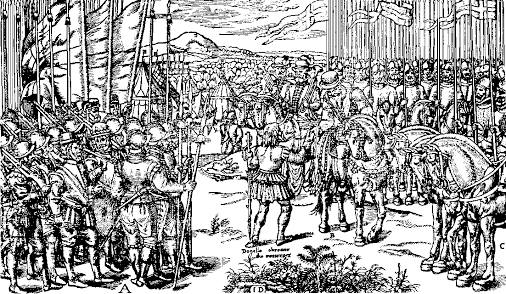
Throughout September, the Daily Classical Music Post celebrates the music of 15th-, 16th-, and 17th-century England. https://youtu.be/jomZcpqkfUI The great English composer William Byrd (1543–1623) wrote his wonderfully descriptive virginals piece "The Battell" after the great Armada victory of 1588, although most musicologists believe that it is more likely to have been inspired by a smaller skirmish, perhaps an uprising of some sort. Sally Mosher has said of "The Battell": "By the 17th century, battle pieces had become a popular genre, so Byrd can be said to have launched a new keyboard genre in addition to composing the first English keyboard suite. All in C major, sections of ‘The Battle’ are harmonically very simple; for the most part they alternate between the tonic and the dominant, using no more than a handful of chords. Like the march, they often suggest trumpets and drums, but they also quite successfully suggest the sounds of soldiers marching, of ho...

Thomas Ravenscroft's "Three Blinde Mice"

Image
Throughout September, the Daily Classical Music Post celebrates the music of 15th-, 16th-, and 17th-century England. https://youtu.be/AMjPA2_CNdc The English composer Thomas Ravenscroft (c. 1588–1635) was particularly notable for his rounds and catches. He was a chorister at St Paul's Cathedral, and he did compose some well-known sacred music, including the Christmas carol "Remember, O Thou Man," but it is his secular music that really shines. I don't think that there can be anyone who hasn't heard of, and probably sung, some version of "Three Blind Mice." What most people will NOT know is that the rhyme was most likely written by Ravenscroft, and he also wrote the music. This lovely little ditty became a staple of childhood literature in the mid-19th century -- with very different words. There is speculation that the original text -- "Three Blinde Mice, / Three Blinde Mice, / Dame Iulian, / Dame Iulian, / the Miller and his merry olde Wife, / she s...