Posts

Rebecca Clarke's Viola Sonata
Image
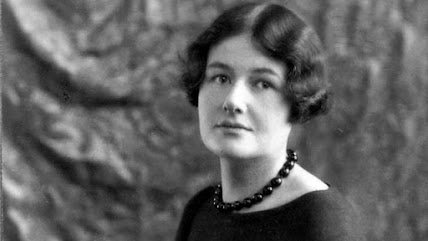
This March, the Daily Classical Music Post will introduce you to some of the most wonderful music ever composed—and, yes, it will all be by women composers! https://youtu.be/NxtbFlnxiMk   The English composer and violist Rebecca Clarke (1886–1979) was known primarily as a performer. Her output as a composer is, sadly, small; she once said, "I can't do it unless it's the first thing I think of every morning when I wake and the last thing I think of every night before I go to sleep." According to the Rebecca Clarke Society ( http://www.rebeccaclarke.org/ ), "Rebecca Clarke achieved what she called 'my one brief whiff of fame' in 1919 when her Viola Sonata tied for first place in a competition sponsored by Elizabeth Sprague Coolidge. Clarke lived much of her life in the US, although she was born and educated in Great Britain. Striking for its passion and power, her music spans a range of 20th-century styles including Impressionism, post-Romantic, and neo-Cla...

Vítězslava Kaprálová’s Grotesque Passacaglia

Image
This March, the Daily Classical Music Post will introduce you to some of the most wonderful music ever composed—and, yes, it will all be by women composers! https://youtu.be/tFehvrBhTvQ Vítězslava Kaprálová (1915–1940) was a Czech composer and conductor. She died at the age of 25 from what was thought to be tuberculosis in a hospital in France. She only composed around 50 works, but it is obvious from what she accomplished in her short life that she would have been an incredibly vital voice and a major composer. Kaprálová had a very distinctive style, blending impressionism with Czech modernism. She was the student—and lover—of the great Czech composer Bohuslav Martinů, who was devastated by her death. In 1942, he wrote: "Why had destiny given her so much energy, so many precious gifts, and yet denied her the opportunity to realise her full potential? This question, I think, will remain forever unanswered." And several of Martinů’s works are either dedicated to her or in some...

Elisabetta Brusa's Simply Largo

Image
This March, the Daily Classical Music Post will introduce you to some of the most wonderful music ever composed—and, yes, it will all be by women composers! https://youtu.be/KMNiUEJG0Fk The Italian composer Elisabetta Brusa (born 1954) began composing before she was five years old! Her composition teachers included Peter Maxwell Davies, Hans Keller, Hans Werner Henze, and Gunther Schuller. Brusa has written many orchestral works, including symphonies and several tone poems, as well as chamber works and solo instrumental pieces. She describes her style as "close to Neo-Tonality and in particular to Neo-Romanticism, but in the original sense of the word, which is nowadays often confusedly assimilated to other ones," and her harmony as "essentially pandiatonic with panchromatic moments." She won first prize at the Washington International Competition for Composition for String Quartet in 1982, and also has been the recipient of several other awards. She has said, ...

Amanda Aldridge’s Moorish Pictures, I: Prayer Before Battle

Image
This March, the Daily Classical Music Post will introduce you to some of the most wonderful music ever composed—and, yes, it will all be by women composers! https://youtu.be/68sUH36DEzs It’s not all that easy to find recordings of music by Amanda Aldridge (1866–1956), even when you know that she composed under the pseudonym of Montague Ring. Aldridge, the daughter of the African American Shakespearean actor Ira Aldridge, was best known as an opera singer. She studied voice with, among others, Jenny Lind at the Royal College of Music. Her singing career ended when she had a particularly bad bout of laryngitis, which permanently damaged her throat. She turned to teaching and composing. Most of her works were what was known as “parlour music,” which means that they were performed in people’s homes. Ray White points out that Aldridge inspired Paul Robeson and Marian Anderson: “Amanda Aldridge was able to inspire up-and-coming actor and singer Paul Robeson with the confidence and technique ...

Jennifer Fitzgerald's Pocket

Image
This March, the Daily Classical Music Post will introduce you to some of the most wonderful music ever composed—and, yes, it will all be by women composers! http://www.pulsoptional.org/jennifer-fitzgerald/…/Pocket.mp3 The American composer Jennifer Fitzgerald (born 1975; died 2007) was only 32 when she died following a long battle with cancer. In her short career, she wrote some fascinating and intriguing music for, as she put it on her website, "unusual instrumental combinations." Part of the reason for this was, as she said, this was "the result of my years as the pianist for pulsoptional, 'North Carolina’s Band of Composers', which boasts the highly unusual instrumentation of oboe, bassoon, violin, two electric guitars, percussion and piano." Jennifer's legacy is preserved on the pulsoptional website ( http://www.pulsoptional.org/jennifer-fitzgerald/ ), and you can hear some excerpts of her work there. I can't remember when I first heard her piece...

Germaine Tailleferre's Sonata for Harp

Image
This March, the Daily Classical Music Post will introduce you to some of the most wonderful music ever composed—and, yes, it will all be by women composers! https://youtu.be/Pf9PmVLo5Xk Germaine Tailleferre ( 1892–1983) was the only female member of Les Six, the group of French composers who joined together in part as a reaction against the musical style of Wagner, Debussy, and Ravel. Jean Cocteau helped to form this avant-garde group: Tailleferre, Georges Auric, Louis Durey, Arthur Honegger, Darius Milhaud, and Francis Poulenc were its members. Tailleferre wrote several of her most important works in the 1920s, including ballet scores. She wrote a lot of film music in the 1930s. She spent most of World War II in the United States. She returned to France in 1946 and continued to compose until a few weeks before she died. Her Sonata for Harp was written in 1953, and it is a beautiful, ethereal work. It was composed for and is dedicated to the Spanish harpist Nicanor Zabaleta. James Reel...

Alison Bauld's Farewell, Already

Image
This March, the Daily Classical Music Post will introduce you to some of the most wonderful music ever composed—and, yes, it will all be by women composers! https://youtu.be/y3VxF17TAeQ Alison Bauld was born in Australia in 1944, and she moved to England to study with Elisabeh Lutyens and Hans Keller in the early 1970s. Her background as an actress as well as a musician certainly informed her works—they all have a strong theatrical element, and are very exciting to listen to and to hear/see live. In 1985, Bauld was commissioned to write a radio piece for the BBC, and the result was the extraordinary Richard III for multitracked speaker and string quartet. Bauld actually gave the premiere of this herself with the Arditti String Quartet. In 1993, she decided to adapt this for solo voice (stylized speech, speech-song, and song) and string quartet, and this new version is called Farewell, Already . As Bayern Northcott says, "The text is a composite of Lady Anne's lamentations ove...